


Louis PoulsenSuunnittelu: Louis Poulsen A/S
Delivery to Unkari: 1–3 business days (after dispatch)
Doo-Wop-riippuvalaisin kantaa mukanaan palan tanskalaista laitoshistoriaa. 1950-luvulla Navy Pendant -nimellä esitelty valaisin — jonka Louis Poulsen kehitti laivaston rakennusosaston kanssa — valaisi vuosikymmenten ajan laivaston ruokaloita ja toimistoja, kunnes se katosi 1980-luvun alussa. Vuonna 2012 se herätettiin henkiin ja nimettiin uudelleen aikakautensa lauluperinteen mukaan; se valmistetaan yhä perinteiseen tapaan: jokainen kaksoisvarjostin pyöräytetään käsin, ja hienot rullatut reunat antavat siluetille sen pehmeän, kerroksellisen tilavuuden, kun valkoinen sisäheijastin ohjaa valon lempeästi alaspäin.
Nykyään Doo-Wop näyttäytyy hillittynä mid-century-aitoutena: ripusta yksi matalalle yöpöydän tai keittiötason ylle, tai aseta useampi riviin ruokailubaarin varrelle — lakkaamattomat messinki- ja kupariversiot hehkuvat iltaisin kauniisti. Katso lisää riippuvalaisimia tai selaa Louis Poulsen -mallistoa.
Valonlähde: E27, 1 lamppu, enintään 60 W. IP20, sisäkäyttöön. Lamppu ei sisälly toimitukseen.
| Brand | Louis Poulsen |
|---|---|
| Designer | Louis Poulsen A/S |
| Item number | 5741093410 |
| EAN | 5703411243657 |
| Mitat (mm) | 283 (leveys) x 245 (korkeus) x 283 (pituus) |
| Paino | 2,2 kg (maalattu) / 4,0 kg (messinki) |
| Material | Varjostin: painosorvattu lakkaamaton messinki, kupari tai jauhemaalattu painosorvattu alumiini (valkoinen, tummanharmaa). Ripustus: puristettu alumiini. Jalka: ruostumaton teräs. Johto: 3 m valkoista kangasta. Kattokuppi sisältyy. |
| Väri | White |
- Delivery to Unkari: 1–3 business days (after dispatch).
- 30-day returns.
Louis Poulsen
The Danish Navy's 1952 pendant, spun by hand
The Doo-Wop began in 1952 as the Navy Pendant, developed by Louis Poulsen with the Danish Navy Buildings Department. It lit naval offices and canteens and stayed in the catalogue until the early 1980s. Demand from antique shops and auctions brought it back in 2012, made the same way.
- 1952Year it was first introduced
- 2012Year production resumed
- 2Shades: an inner diffuser and a solid outer shade
- 28.3 cmDiameter, 24.5 cm high
Spun by hand
Each shade is turned by hand and bent up at the edge, as in the 1950s.
Soft and directed
The inner shade diffuses the light, while the outer shade sends it up and down.
Metal or colour
Spun brass and copper, or painted aluminium in white and dark grey.
Born in naval buildings
It was made for naval buildings and later found its way into homes.
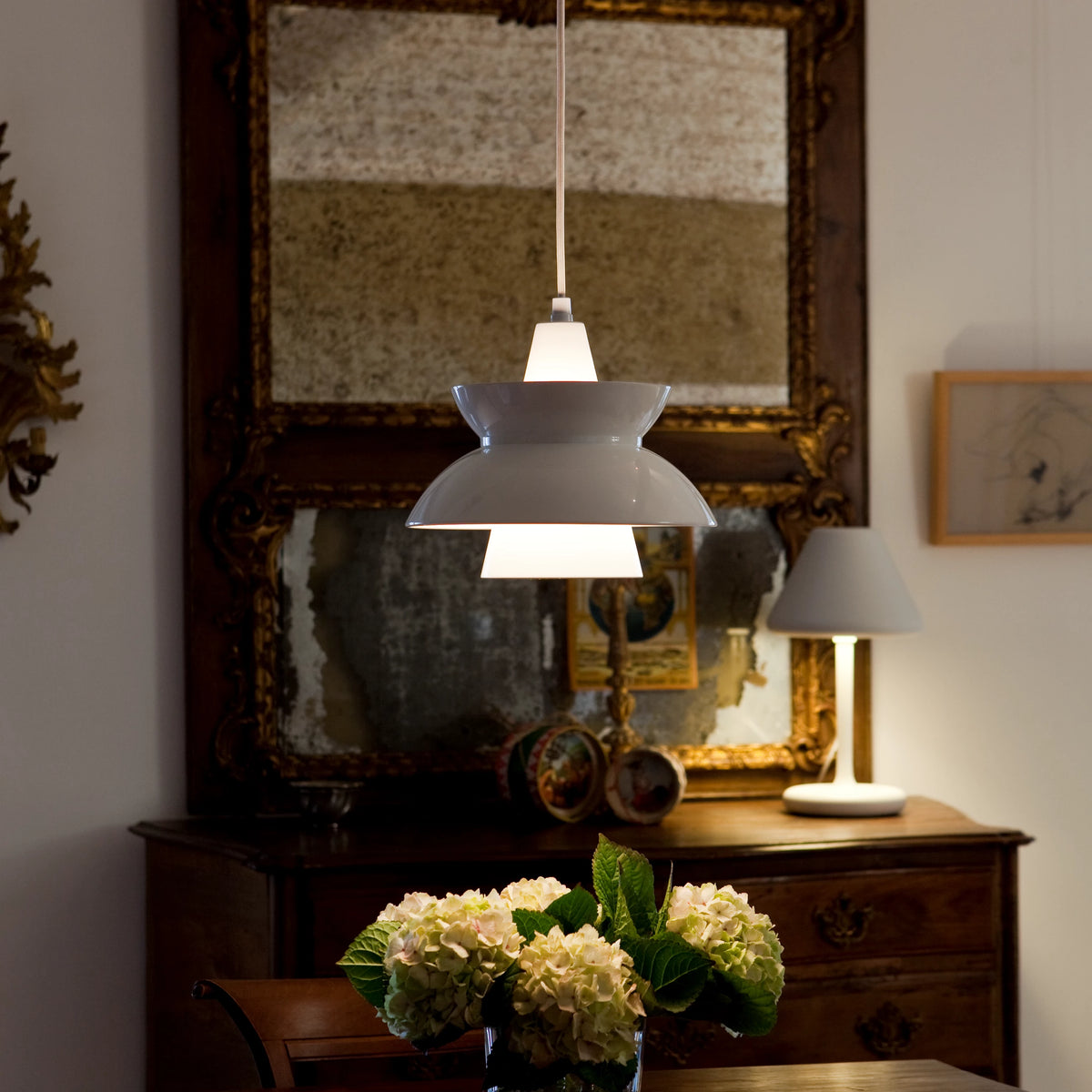
From the Navy
Louis Poulsen developed the pendant in close partnership with the Navy Buildings Department. It hung in naval offices and canteens, and it also became popular with customers outside the Navy.

A spinning craft
The shades are made with a demanding spinning technique developed by Louis Poulsen's craftsmen. A flat metal sheet is turned into the double shade, then the edge is bent up slightly to give the shade its volume.

Where it fits
At 28.3 cm across, the Doo-Wop suits a kitchen table, a row over an island or a workspace. Brass and copper versions bring warmth; painted versions keep it simple. The outer shade also sends some light upward.
Materiaalit
Spun brass or copper
Unlacquered, so it darkens with time; dust with a dry cloth.
Painted aluminium
Powder-coated in white or dark grey for a quiet finish.
Fabric cord
A 3 m white fabric cord with canopy.
Suunnittelija ja merkki
Louis Poulsen design team
The Doo-Wop was developed in the 1950s by Louis Poulsen together with the Danish Navy Buildings Department. It was renamed after the vocal music of its era when it returned in 2012. Its shades are still hand-spun by the company's craftsmen.
Käyttö kotona
How high should I hang it?
About 60–70 cm above a table or kitchen island.
Will brass and copper change?
Yes. They are unlacquered and slowly develop a patina.
Can I dim it?
Yes, with a dimmable bulb and a compatible dimmer.
How many should I hang?
One suits a small table. Over a long table or island, two or three in a row work well.
How do I clean it?
Let it cool and wipe it with a soft, dry cloth. Skip metal polish if you want the patina.
-
 ALKUPERÄINEN DESIGN
Valtuutettu jälleenmyyjä kaikille merkeille, takuuvarmasti 100 % aitoja tuotteita.
-
 ASIANTUNTIJATUKI
Asiantuntijamme neuvovat sinua, tuotteen valinnasta aina hoito-ohjeisiin asti.
-
 ILMAINEN TOIMITUS
Free delivery to Unkari on every order
-
 TURVALLINEN MAKSAMINEN
Käytämme vain luotettuja palveluntarjoajia, joten maksaminen on turvallista ja sujuvaa.


