


Louis PoulsenDesign: Poul Henningsen
Delivery to Hungary: 1–3 business days (after dispatch)
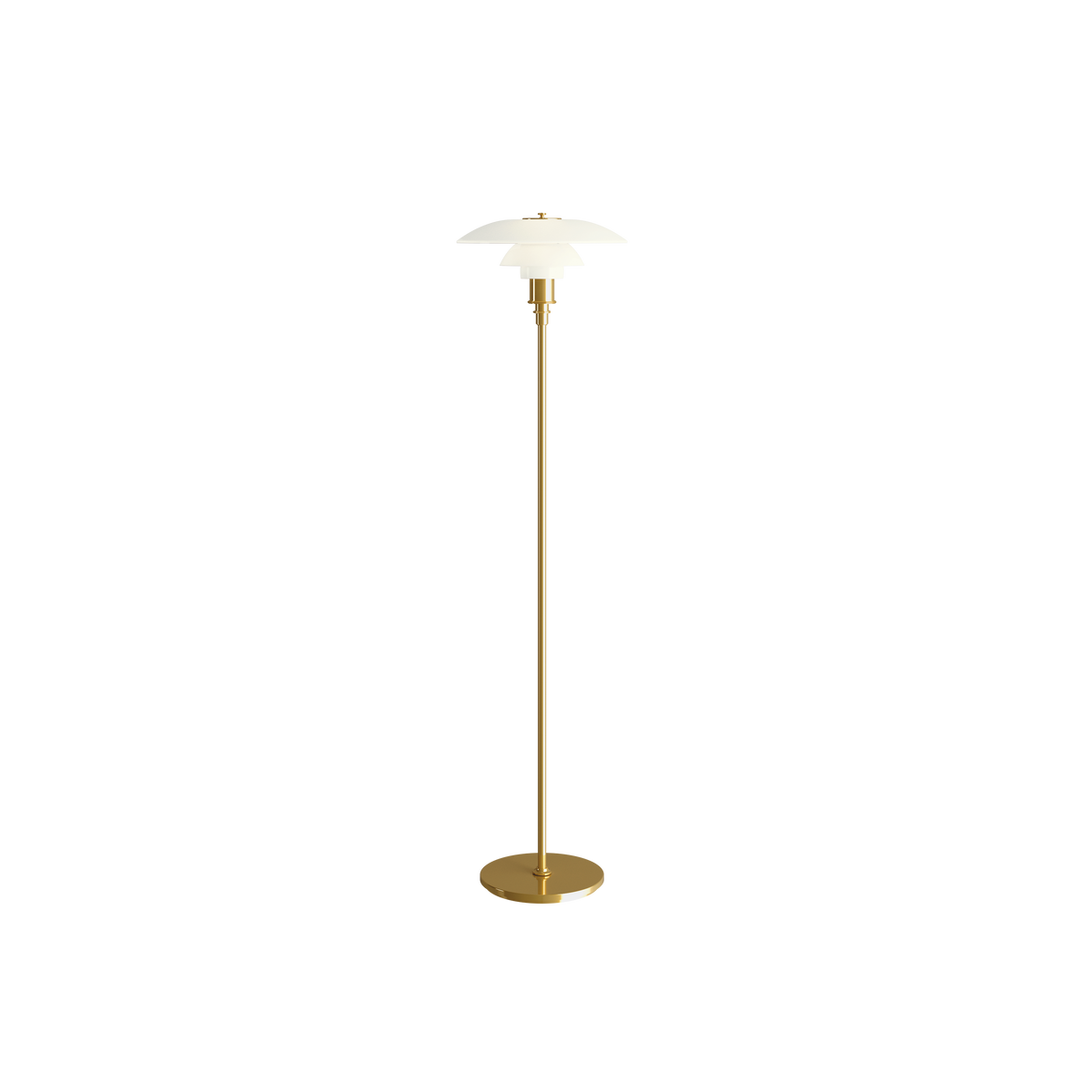
The PH 3½-2½ Floor Lamp brings Poul Henningsen's three-shade system to reading height: a 33 cm top shade in mouth-blown white opal glass over smaller lower shades, all curved on his logarithmic spiral for glare-free, evenly distributed light.
The System PH dates from 1926, born of Henningsen's gold-medal Paris lamp of 1925; Louis Poulsen's 2002 re-edition faithfully reproduces the original geometry with modern electrics.
Standing about 1.3 m tall, it is the natural companion for a reading chair or sofa corner, operated by an on/off foot switch. Explore more designer floor lamps or the full Louis Poulsen collection.
Light source: E27 (E26 compatible), 1 bulb, max 70 W. Indoor. Bulb not included — we recommend an E27 LED (8.5–10 W, 1055 lm).
| Brand | Louis Poulsen |
|---|---|
| Designer | Poul Henningsen |
| Item number | 5744162199 |
| EAN | 5703411127124 |
| Ø | 330 mm |
| Height | 1300 mm |
| Cable | 2.5 m |
| Weight | 15.0–16.1 kg |
| Material | Mouth-blown white opal glass. High-lustre chrome plated, black metallised or brass metallised; spun brass and steel. Cord: 2.5 m plastic. On/off foot switch provided. |
| Color | High lustre chrome plated |
- Delivery to Hungary: 1–3 business days (after dispatch).
- 30-day returns.
Louis Poulsen
PH 3½-2½: Henningsen's 1928 three-shade lamp
Poul Henningsen designed the PH 3½-2½ in 1928, two years after he set out his three-shade system with Louis Poulsen. Three shades on the logarithmic spiral hide the bulb and send light down and out. Table, metal table and floor versions share the same geometry.
- 1926Year of the three-shade system
- 1928Year the PH 3½-2½ was designed
- 33 cmTop shade diameter
- 3Shades in every lamp
Glare-free by design
The shades are placed so the bulb is never visible, and most light is directed downward.
Glass blown by mouth
Three-layer opal glass, glossy on top and sandblasted underneath, gives soft, even light.
A version for each room
Glass table lamp, metal table lamp with coloured top shade, floor lamp and an aged brass Centenary Edition.
The model number explains it
The 3½ top shade and the 2½ lower shades follow Henningsen's naming by shade size.

An answer to the low pendant
Henningsen finished his first PH table lamp in early 1927 as an alternative to low-hanging pendants. The PH 3½-2½ of 1928 was one of several lamps he built on the new three-shade system.

Shades on a spiral
Each shade follows a logarithmic spiral with the light source at its focal point. Light meets every shade at the same angle, so it reflects evenly and leaves the lamp without glare.
Glass, metal or aged brass
The metal table lamp uses Henningsen's first shade holder with adjustment screws and a spun aluminium top shade. The Centenary Edition pairs an amber top shade with aged, lacquered brass.
Materials
Three-layer opal glass
Each shade is mouth-blown, so small variations in thickness are normal and part of the craft.
Spun brass and steel
Frames come chrome plated, black or brass metallised, silk matt brown brass, or aged lacquered brass on the Centenary Edition.
Spun aluminium top shade
On the metal table lamp, in white, red, yellow or green, with a white rolled edge and a white underside.
Designer and brand
Poul Henningsen
1894–1967
Henningsen was born in Copenhagen and studied at technical schools in Frederiksberg and Copenhagen, though he never graduated as an architect. He began working with Louis Poulsen in 1924, a partnership that lasted his life. In 1926 he set out the three-shade system his lamps still follow.
Using it at home
Which bulb should I use?
The table lamps take one E14 bulb of up to 60 W, and the Centenary floor lamp one E27 bulb of up to 70 W. A warm white LED of 2700 K suits the opal glass.
Table, metal table or floor lamp?
The glass table lamp glows all over, the metal version has a solid coloured top shade, and the 130 cm floor lamp lights a reading chair.
How is the floor lamp switched?
The standard floor lamp has an on/off foot switch on the cord.
How do I clean the glass shades?
Let the lamp cool, then wipe the glass shades gently with a soft, damp cloth and dry them.
Will the brass change?
The Centenary Edition's aged brass is lacquered to keep its patina. Dust it with a soft, dry cloth.
-
 ORIGINAL DESIGN
Authorized dealer for every brand, 100% authentic guaranteed.
-
 EXPERT SUPPORT
Count on our specialists for advice, from selection to aftercare.
-
 FREE SHIPPING
Free delivery to Hungary on every order
-
 SECURE PAYMENT
We only use trusted providers for a safe, seamless checkout.


