


TECNOLUMENDesign: Wilhelm Wagenfeld
Arrives Nov 16 to 25 to Hungary
In stock at TECNOLUMEN's warehouse, dispatched in 2‑3 weeks
- Dimensions
- 440 (width) x 500 (height) x 440 (length) mm · Base Ø 170 mm
- Material
- Nickel-plated metal with a glass shaft and glass base
- Light source
- E27 (E26 compatible), 1 bulb, max 60 W. IP20, indoor. Bulb not included.
- Weight
- 30-day returns
- Authorized dealer
- Secure payment
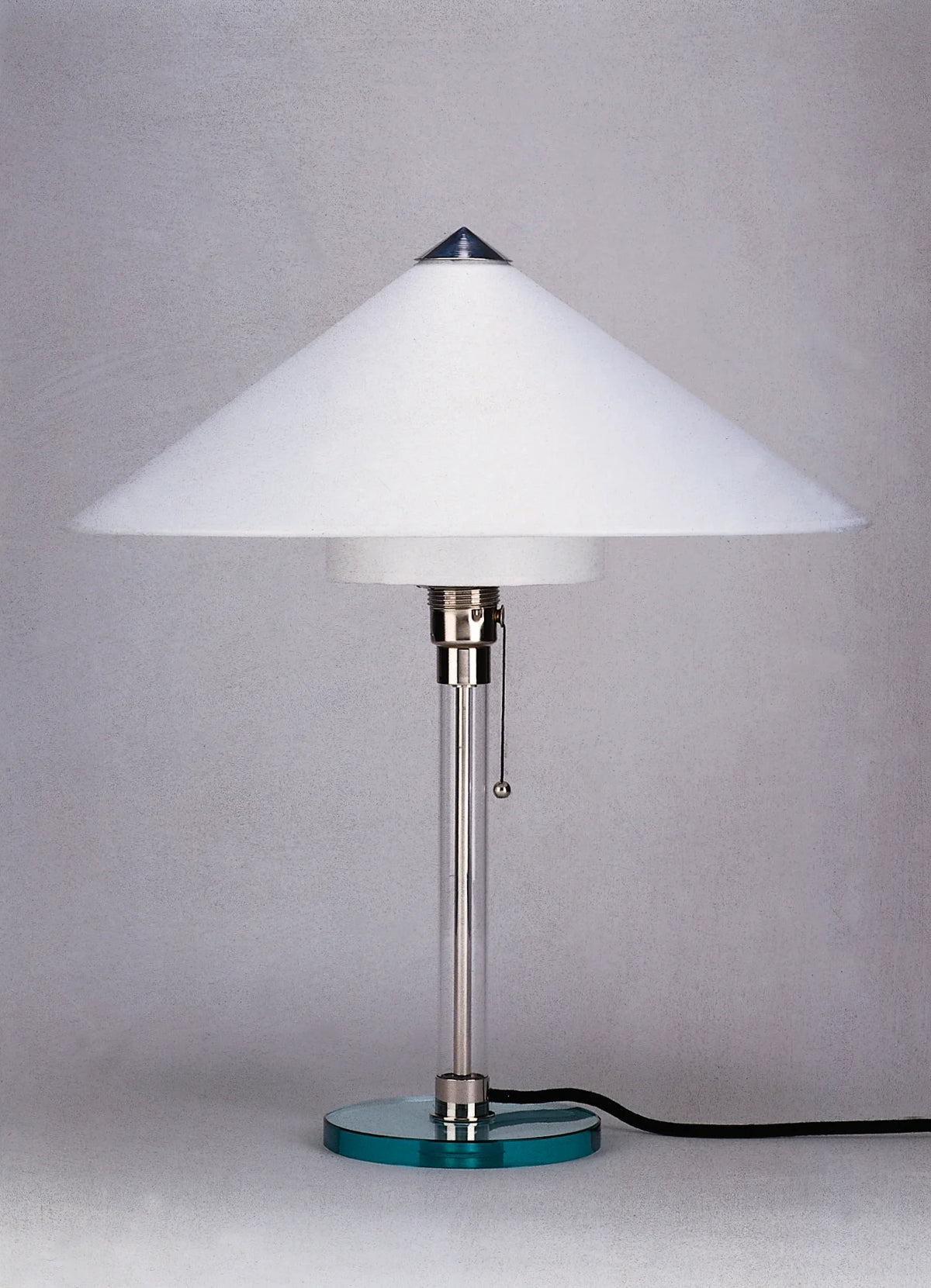
Wilhelm Wagenfeld's WG 27 (1927) explores a fabric shade over a glass shaft and base. TECNOLUMEN replaces the original cellon with a safer synthetic while preserving the balanced lines, uniting warm diffusion with Bauhaus clarity — a sign of Wagenfeld's continuous experimentation. Every lamp is numbered and bears the TECNOLUMEN signet.
The WG 27 dates from 1927, three years after the lamp that made Wagenfeld's name, and it shows the young designer testing how far the Bauhaus vocabulary could stretch toward domestic warmth. The foundation is familiar — a clear glass base and shaft that let light and sight pass straight through — but above it sits a softly drawn shade, originally cut from cellon, an early synthetic sheet material that glowed gently when lit. The result reads less like a manifesto and more like a lamp to live with: the geometry stays disciplined while the light becomes warmer and more intimate. It is a quiet reminder that Wagenfeld was never a dogmatist. He kept experimenting with materials throughout his long career as an industrial designer, always in the service of usefulness, and this lamp captures that curiosity at an early, formative moment. TECNOLUMEN's re-edition keeps the balanced proportions of the original, and the signet and serial number mark each lamp as part of the authorised edition rather than one of the many loose interpretations on the market.
That warmer character makes the WG 27 one of the most versatile lamps in the Wagenfeld family. Where the opal glass dome models cast a cool, even glow, the shaded WG 27 gives a cosier, more enveloping light that suits reading corners, bedside tables and living rooms — anywhere softness matters more than statement. In a compact city apartment it can easily carry a whole seating corner on its own in the evening, and its transparent glass body keeps the visual footprint light even on a small side table. It sits comfortably in mid-century, classic and contemporary interiors alike. Find its siblings in our TECNOLUMEN collection, compare silhouettes across our other designer table lamps, and if you are planning the lighting for a smaller home, our guide to designer lighting for small apartments offers practical ways to layer warm and functional light.
Light source: E27 (E26 compatible), 1 bulb, max 60 W. IP20, indoor. Bulb not included — we recommend an E27 LED (6–9 W, 480–810 lm).
| Brand | TECNOLUMEN |
|---|---|
| Designer | Wilhelm Wagenfeld |
| Item number | WG 27 |
| EAN | |
| Size (mm) | 440 (width) x 500 (Height) x 440 (Length) |
| Dimensions | Base Ø 170 mm |
| Cable length | 2.5 m |
| Material | Nickel-plated metal with a glass shaft and glass base, topped by a wide conical heat-resistant synthetic shade covered in fabric. Each lamp consecutively numbered with the TECNOLUMEN signet. |
- Delivery to Hungary: 1–3 business days (after dispatch).
- 30-day returns.

TECNOLUMEN
Wagenfeld's fabric-shade lamps from Weimar, 1927–28
Wilhelm Wagenfeld designed the WG 27 in 1927 and the WG 28 in 1928, both in Weimar. Each sets a wide fabric shade over a clear glass shaft and glass foot. They show a softer, more domestic side of the Bauhaus designer. TECNOLUMEN numbers every lamp.
- 1927WG 27 designed
- 1928WG 28 designed
- 44 cmShade diameter of both lamps
- 50 cmHeight of both lamps
Glass that seems to float
The clear glass foot and shaft make the lamp look light, with nickel-plated parts as cool accents.
Warm, filtered light
The fabric shade softens the light for sideboards, bedrooms and reading corners.
Two outlines, one family
The WG 27 has a straight lower shade. The WG 28 has a conical one that flares out.
Authorised and numbered
The WG 28 is the only re-edition Wagenfeld authorised, and every lamp carries a running number and the TECNOLUMEN mark.

After the Bauhaus lamp
These lamps followed Wagenfeld's famous WG 24 of 1924. Glass, metal and simple geometry still shape them, but the big fabric shade makes them softer. Wagenfeld saw design as a continuing search for the best form.

From cellon to fabric
The original shades were cellon, an early plastic that no longer meets safety rules. TECNOLUMEN uses a heat-resistant synthetic shade covered in fabric, keeping the proportions and the character of the design.
Where they belong
With a 44 cm shade and a height of 50 cm, both lamps suit sideboards, consoles, living rooms and bedrooms. They also sit well in libraries and hotels, anywhere a calm light matters.
Materials
Clear glass
The glass shaft and foot give the lamp its open look; clean with a soft, lint-free cloth.
Nickel-plated metal
Nickel rather than chrome, as on Wagenfeld's originals; it can take on a fine, slightly yellow patina with time.
Fabric-covered shade
A heat-resistant synthetic shade under fabric; dust it with a soft brush.
Designer and brand
Wilhelm Wagenfeld
1900–1990
Wagenfeld trained as a silversmith and entered the Bauhaus metal workshop in Weimar in 1923, where he designed the WG 24. In 1928 he took over the metal workshop of the Weimar Bauhochschule. He went on to design glass for Schott and household goods for WMF, more than 600 designs in all.
Using it at home
Which bulb should I use?
One E27 bulb. TECNOLUMEN suggests a matt 7 W LED.
WG 27 or WG 28?
Same glass base and the same size. The WG 27 shade has a straight lower part; the WG 28 shade flares into a cone.
How long is the cable?
2.5 m, enough to reach a socket behind a sideboard or bedside table.
Will the metal change colour?
Nickel can develop a fine, slightly yellowish patina over the years. It belongs to the original finish.
How do I clean it?
Unplug and let it cool. Dust the shade with a soft brush and wipe glass and metal with a soft cloth.
-
 ORIGINAL DESIGN
Authorized dealer for every brand, 100% authentic guaranteed.
-
 EXPERT SUPPORT
Count on our specialists for advice, from selection to aftercare.
-
 FREE SHIPPING
Free delivery to Hungary on every order
-
 SECURE PAYMENT
We only use trusted providers for a safe, seamless checkout.


