PH 4/3 Pendant or PH 4½-3½ Floor Lamp: over the table or by the chair?
Hang the 40 cm metal PH 4/3 Pendant 50–60 cm over a table; stand the 126 cm opal glass PH 4½-3½ Floor Lamp beside a reading chair.

Short answer: Choose the PH 4/3 Pendant if the light belongs over a dining table, kitchen counter or wide desk and you have a ceiling point there. Choose the PH 4½-3½ Floor Lamp if it belongs beside a reading chair or sofa, needs no installation and should glow through opal glass rather than throw a crisp pool of light. They are related PH designs, not the same shade at two heights.
The two names look almost identical, and both carry Poul Henningsen's layered shades, so it is easy to assume one is simply the other on a stem. It is not: one is a 40 cm all-metal pendant from 1966; the other is a 45 cm opal glass floor lamp that entered the Louis Poulsen catalogue in 1990.
What the numbers in the names tell you
Henningsen began developing his multi-shade lamp with Louis Poulsen in the mid 1920s, and the PH numbers name the shades: the first figure refers to the top shade, the second to the lower one. So the PH 4/3 has a top shade of about 40 cm (its listed width is 400 mm), while the PH 4½-3½ has a 45 cm top shade. If you want the full logic of the numbering, our piece on how the PH three-shade system works goes through it.
Both follow the same optical idea. The shades sit on curves derived from the logarithmic spiral, with the bulb at the focal point, so light is reflected downward and outward and the source stays hidden from normal viewing angles. What differs is the material doing the reflecting, and that changes the character of the light more than the 5 cm difference in width.

Side by side: metal pendant, glass floor lamp
| PH 4/3 Pendant | PH 4½-3½ Floor Lamp | |
|---|---|---|
| Designed | 1966, a reworking of a 1929 model | Late 1920s drawings; floor version catalogued in 1990 |
| Shades | White lacquered aluminium, white-painted inner sides | Mouth-blown three-layer white opal glass |
| Size | 40 cm wide, 20 cm high | 45 cm wide, 126 cm high |
| Weight | 2.5 kg | 34.3 kg |
| Bulb | E27, max 60 W | E27, max 100 W |
| Power | 3 m white fabric cord, canopy included, wired to the ceiling | 3.3 m black cord with plug, switch on the cord |
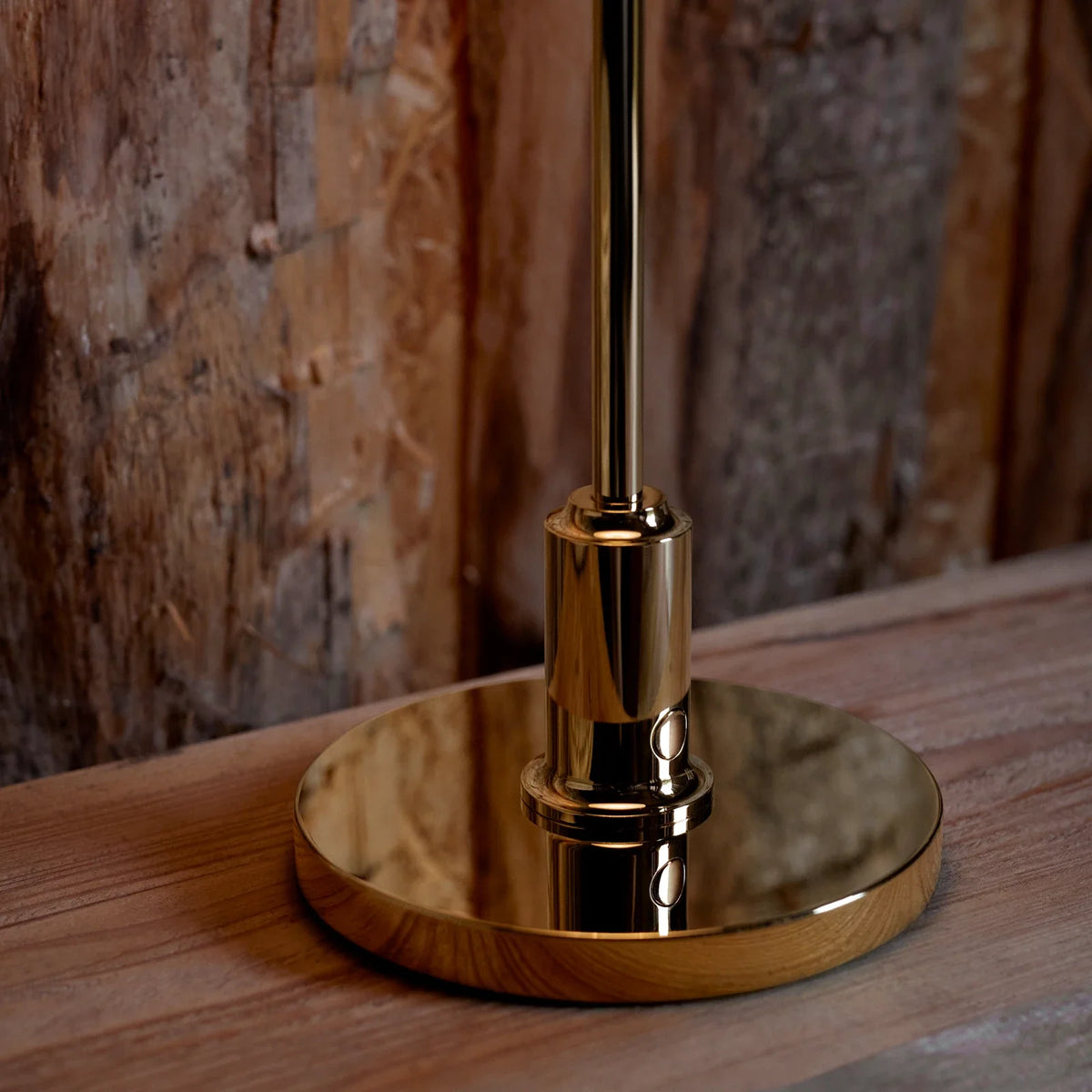
| Body | All metal | Chrome-plated brass and steel stem and top plate |
| Light character | Directed pool on the surface below | Downward reading light plus a glow from the shades |
Two rows matter most. The shade material decides whether the lamp lights the room or only the table. The power row decides whether you need an electrician: the pendant needs a ceiling outlet, the floor lamp needs only a socket within 3.3 m.
The pendant over a table: worked heights
The PH 4/3 is made to hang 50–60 cm above a dining table, kitchen counter or wide desk. Because the aluminium shades let no light through, everything above the rim stays relatively dark and the surface below gets the light. That is what you want over a table: faces and plates lit, no bulb in anyone's eyes.
Here is how the numbers work with a common 75 cm table height:
- Bottom of the shade at 50–60 cm above the top: 125–135 cm from the floor.
- Add the 20 cm shade height: the top of the lamp sits at 145–155 cm.
- Under a 250 cm ceiling, that leaves 95–105 cm of cord between canopy and lamp.
- Under a 280 cm ceiling: 125–135 cm of cord. The 3 m cord covers both with plenty to spare before shortening.
A 40 cm shade is a modest diameter. We would use one over a round or square table for two to four, or over a desk. Over a long table it reads small on its own, and you would either hang two or look at a larger PH. The 60 W maximum is enough for this job because the light travels less than a metre to the table.
The floor lamp by a chair: what the glass changes
The PH 4½-3½ uses mouth-blown three-layer opal glass. The shades still send the main light down and out, so a book on your lap is lit without glare, but the glass itself glows. In practice the lamp does two jobs: a reading light for one seat and a soft light for the corner around it. That is why it can stand close to seating.

Three practical checks before you choose a spot:
- Height: the lamp is 126 cm tall. Set it beside the chair, slightly behind your shoulder, so the shade is above eye level and the light falls onto the page rather than across your face.
- Socket: the cord is 3.3 m and the switch is on the cord, so plan where that switch will lie. Within reach of the chair is better than behind a sofa.
- Weight: at 34.3 kg, almost fourteen times the pendant, it is not a lamp you will shift around every evening. Pick its place once.
Its 100 W maximum, against the pendant's 60 W, gives headroom for lighting a reader and part of the room at once.
Which one we would choose
For a dining table for two to four, a kitchen counter or a wide desk with a ceiling point above it, we would choose the PH 4/3 Pendant. Its metal shades keep the light on the surface, it weighs 2.5 kg, and the 50–60 cm hanging rule is easy to get right with the worked numbers above.
For a reading chair, a sofa corner or a rented flat where you cannot move a ceiling outlet, we would choose the PH 4½-3½ Floor Lamp. It plugs in, needs no ceiling work, and the opal glass softens the whole corner while the page stays lit.
If the room has both a table and a reading corner, they are not either/or. Hang the pendant over the table and stand the floor lamp by the chair; the shared PH outline ties them together while the white metal and opal glass keep each in its own role. More designs from the same family are in our Louis Poulsen collection.