


Arrives Nov 25 to Dec 4 to Hungary
In stock at Arne Jacobsen's warehouse, dispatched in 1‑2 weeks
- 30-day returns
- Authorized dealer
- Secure payment
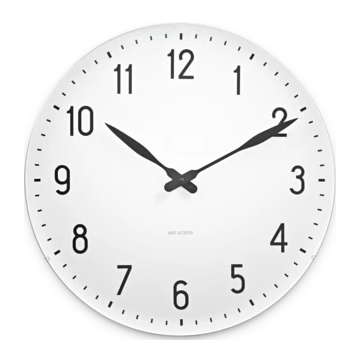
The Station Wall Clock Ø48 cm White/Black is a versatile addition to any collection, blending Nordic simplicity with a warm, tactile finish.
The brushed steel construction is chosen for durability as much as looks, so it holds up well to regular use. A quartz movement keeps timekeeping quiet and accurate. Pair it with matching pieces from the collection to complete the set.
| Brand | Arne Jacobsen |
|---|---|
| Item number | 43663 |
| EAN | 5709513436638 |
- Delivery to Hungary: 1–3 business days (after dispatch).
- 30-day returns.

Compare within the series
This product Station Wall Clock Ø48 cm White/Black |  Station Wall clock Ø29 cm white/black |  Station Wall clock Ø21 cm white/black |  Station Wall clock Ø16.5 cm white/black |  Station Table clock Ø11 cm | |
|---|---|---|---|---|---|
| Size | |||||
| Size | · | Size (cm): 6.5 (height) x 6.3 (depth) Diameter: 29 cm | Size (cm): 5.4 (depth) Diameter: 21 cm | Size (cm): 5 (depth) Diameter: 16.5 cm | Size (cm): 12 (height) x 11.3 (width) x 6.7 (depth) Diameter: 11 cm |
| Material | |||||
| Material | · | Mineral glass lens, alu case, ABS | Mineral glass lens, alu case, ABS | Mineral glass lens, alu case, ABS | PMMA lens, ABS plastic |
| Price | |||||
| Price | €707,52 | €335,70 | €254,10 | €217,55 | €122,35 |
Arne Jacobsen
Station: a 1941 clock face for Lauritz Knudsen
DesignerArne Jacobsen1902–1971
Arne Jacobsen designed the Station clock face around 1941 for Lauritz Knudsen, the Danish electrical maker known as LK, which needed one clock for all kinds of buildings, stations included. Clear numerals and a black top ring give it its graphic look.
- Year Jacobsen designed Station
- 1941
- Year of his first table clock for LK
- 1939
- Wall clock sizes
- 4
- Table clock
- 11 cm
Easy to read
Clear numerals made for public buildings and stations.
A graphic black ring
A top ring in black aluminium frames the white dial.
Wall sizes for any room
16.5, 21, 29 and 48 cm.
A table version
The 11 cm table clock has an alarm with snooze and a light sensor.

A clock for LK
Lauritz Knudsen wanted a universal clock for every kind of building. Jacobsen, who liked to design everything in a project down to the fittings, drew Station around 1941. Even this early design shows his strict, graphic hand.
The first table clock
Jacobsen's earliest clock was a 1939 table clock for LK, shown that year at the Charlottenborg Spring Exhibition, one version on bent steel legs. Station was drawn to replace its original face of numerals and double hands.
The black ring
On the wall clocks a top ring in black aluminium frames the white face and sharpens the graphic effect. The case holds a concave mineral glass, and the clock comes in four sizes, from 16.5 to 48 cm.
Materials
- Mineral glass
- A concave lens on the wall clocks, hard to scratch and clear to read.
- Aluminium case
- Slim and light; it holds the glass slightly away from the wall so the clock seems to float.
- ABS and PMMA
- Light, durable plastics for the table clock body and lens.
Arne Jacobsen helped bring modernism to Denmark around 1930, with work such as the House of the Future. Besides buildings and furniture he designed typefaces, patterns, posters and clocks. His early clocks were made for Lauritz Knudsen, an electrical maker whose CEO had hired him to design his house.
Using it at home
Which size should I choose?
16.5 cm for a kitchen or shelf, 21 cm for an office, 29 cm for a living room and 48 cm for a large wall.
What does the table clock do?
The 11 cm table clock on its metal legs has an alarm with snooze and a light sensor, so it works by the bed as well as on a desk.
Is Jacobsen's name on the dial?
Yes. Today's clocks, made by Rosendahl, carry Arne Jacobsen's name in his original typeface.
How do I clean it?
Dust the case and glass with a soft, dry cloth. For marks on the glass, use a slightly damp cloth and dry it straight away.
Station or City Hall?
Station shows numerals and is the easiest to read; City Hall uses only lines.
-
 ORIGINAL DESIGN
Authorized dealer for every brand, 100% authentic guaranteed.
-
 EXPERT SUPPORT
Count on our specialists for advice, from selection to aftercare.
-
 FREE SHIPPING
Free delivery to Hungary on every order
-
 SECURE PAYMENT
We only use trusted providers for a safe, seamless checkout.


