


Louis PoulsenDesign: Poul Henningsen
Arrives Nov 18 to 27 to Hungary
In stock at Louis Poulsen's warehouse, dispatched in 1‑2 weeks
- Dimensions
- 200 (width) x 236 (height) x 236 (length) mm
- Material
- Wall plate, arm and switch housing in aged, lacquered brushed brass
- Light source
- E14 socket, 1 bulb, max 40 W, IP20 indoor, not dimmable. Bulb not included.
- Weight
- 30-day returns
- Authorized dealer
- Secure payment
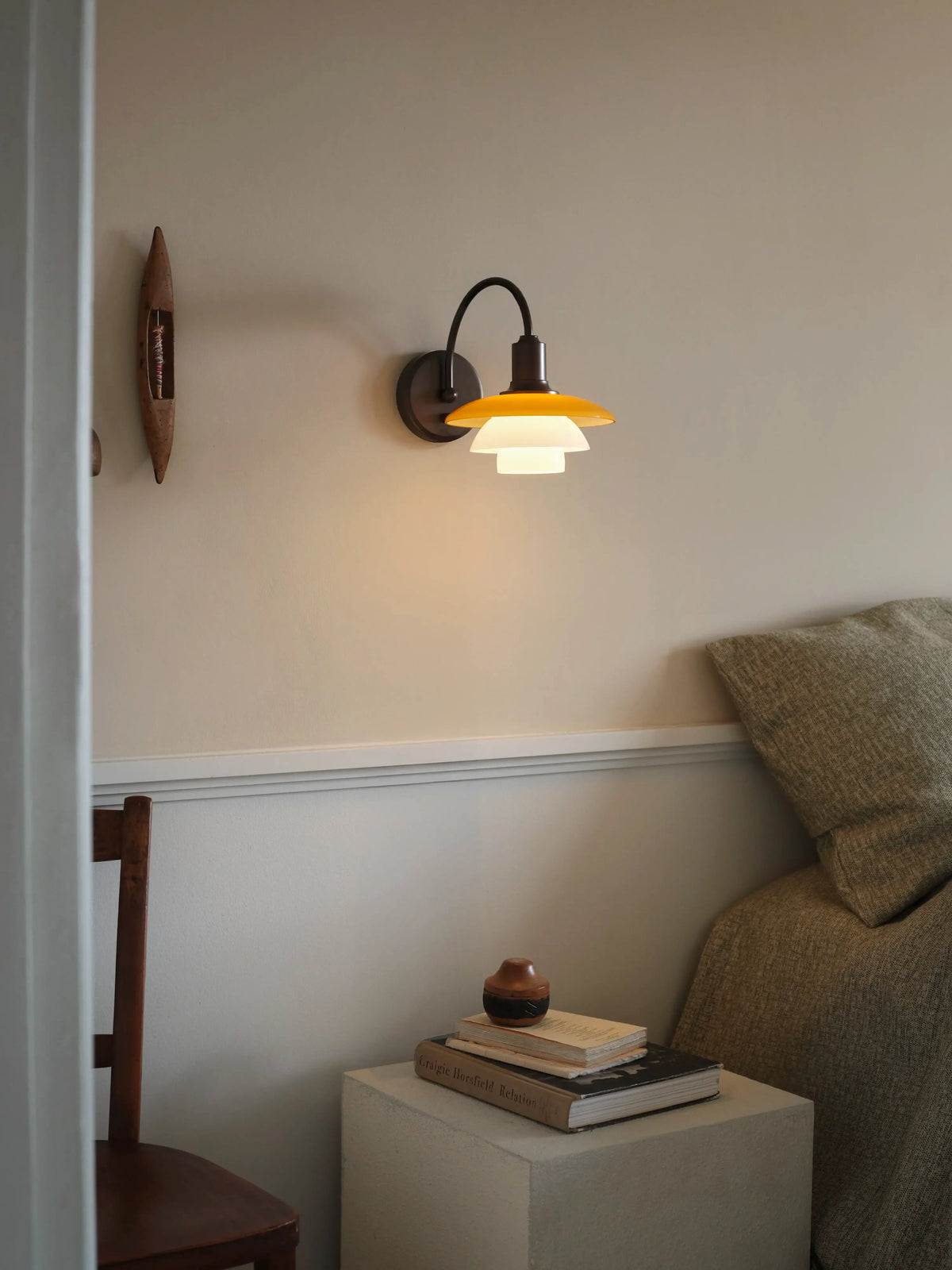
The PH 2/2 Wall Lamp Centenary Edition brings the same anniversary to the wall: System PH, invented by Poul Henningsen in 1926, in its 3:2:1 proportions with a top shade of about 20 cm. The upper shade is four-layered mouth-blown amber glass with a white inner side, the lower shades three-layered mouth-blown white opal glass, glossy outside and sandblasted matt inside. Light from the amber shade washes the wall above the lamp in a warm tone, while the opal glass sends a soft, glare-free light down over whatever sits beneath it.
Wall plate, arm and switch housing are aged, lacquered brushed brass. Three versions are made: with a 2.5 m dark brown textile cord and a switch, without the cord but with the switch, and without cord or switch for hardwiring. At 200 x 236 x 236 mm it stays close to the wall, which suits a corridor, a stairway, a bedside wall, or a pair flanking a mirror.
Light source: E14 socket, 1 bulb, max 40 W, IP20 indoor, not dimmable. Bulb not included.
| Brand | Louis Poulsen |
|---|---|
| Designer | Poul Henningsen |
| Size (mm) | 200 (width) x 236 (Height) x 236 (Length) |
| Cable | 2.5 m (cord version) |
| Material | Wall plate, arm and switch housing in aged, lacquered brushed brass. Upper shade in four-layered mouth-blown amber glass with white inner side; lower shades in three-layered mouth-blown white opal glass, glossy outside and sandblasted matt inside. Dark brown textile cord, 2.5 m, removable for hardwiring. Light source: E14, max 40 W, bulb not included. IP20. |
| Light source | E14 socket, 1 bulb, max 40 W, IP20 indoor, not dimmable. Bulb not included. |
| Cable Type | Dark brown textile cord |
| Control | With switch |
| Item number | 5743151334 |
| EAN | 5714693413850 |
- Delivery to Hungary: 1–3 business days (after dispatch).
- 30-day returns.

Compare with similar Louis Poulsen designs
This product PH 2/2 Wall Lamp Centenary Edition |  PH 3/2 Wall Lamp |  VL Ring Crown 2 Wall Lamp |  LP Grand Wall Lamp |  PH 2/1 Wall Lamp | |
|---|---|---|---|---|---|
| Size | |||||
| Size | Size (mm): 200 (width) x 236 (height) x 236 (length) | Size (mm): 285 (width) x 235 (height) x 285 (length) | Size (mm): 425 (width) x 233 (height) x 305 (length) | Ø 320 Size (mm): 320 (width) x 90 (height) x 320 (length) | Size (mm): 200 (width) x 165 (height) x 296 (length) |
| Light source | |||||
| Light source | E14 socket, 1 bulb, max 40 W, IP20 indoor, not dimmable | E14, 1 bulb, max 40 W | E27, 2 bulbs, max 40 W each | integrated LED, 12 W, 2700 K (3000/4000 K versions available); phase dimmable with standard dimmers | E14, 1 bulb, max 20 W |
| Material | |||||
| Material | Wall plate, arm and switch housing in aged, lacquered brushed brass | Shades in mouth-blown white opal glass | Mouth-blown, three-layered, polished opal glass | Outer shade: wet-painted aluminium (white, champagne or black) | Shades in mouth-blown white opal glass |
| Price | |||||
| Price | €1.097,14 | €1.161,13 | €979,72 | €925,28 | €866,32 |
Louis Poulsen
PH 2/2: Henningsen's smallest three-shade lamps
DesignerPoul Henningsen1894–1967
The PH 2/2 lamps carry Poul Henningsen's three-shade system of 1926 at its smallest scale, with a top shade of about 20 cm. The Question Mark of 1931 and the Luna bedside lamp of the late 1930s tilt their heads. The wall lamp Centenary Edition marks a century of the system.
- Year of the three-shade system
- 1926
- Year of the Question Mark
- 1931
- Approximate top shade diameter
- 20 cm
- Head tilt on the table lamps
- 45°
Small but glare-free
Three shades hide the bulb even at this compact size, so the light is soft on a desk or bedside.
Light you can aim
The Question Mark and Luna heads tilt 45° to the left or right.
Layered mouth-blown glass
Shades are glossy outside and sandblasted inside, for even, comfortable light.
Brass with warm tones
Brushed or aged brass frames that suit the coloured and opal glass.
The question mark stem
Designed in 1931, the Question Mark's curled stem gives it its name. Its head tilts 45° to either side, rare among early PH lamps, which made the light something you could point at a book or a wall.

Luna, the bedside lamp
The PH 2/2 Luna debuted in the late 1930s and was known as the bedside lamp; its name refers to night-time use. Its curved aged-brass stem tilts the opal shades toward the reader and away from a sleeping partner.

A century of System PH
The wall lamp Centenary Edition pairs a four-layer amber upper shade with white opal lower shades. The amber sends warm light upward onto the wall, while the opal shades send soft, glare-free light down.
Materials
- Mouth-blown layered glass
- Opal, amber or pale rose, glossy outside and sandblasted inside; wipe with a soft, damp cloth when cool.
- Brushed or aged brass
- Untreated brass darkens over time; lacquered aged brass keeps its finish.
- Textile cord
- Cords are textile, in white, black or dark brown depending on the lamp.
Henningsen was born in Copenhagen and studied at technical schools in Frederiksberg and Copenhagen, though he never graduated as an architect. He began working with Louis Poulsen in 1924, a partnership that lasted his life. In 1926 he set out the three-shade system his lamps still follow.
Using it at home
Which bulb should I use?
A small, low-wattage warm white LED. The wall lamp takes one E14 bulb of up to 40 W; check the socket listed for your table lamp.
Where do these lamps fit best?
On a bedside table, a desk or a shelf, or on the wall beside a bed or sofa.
How do I tilt the head?
On the table lamps, turn the shade holder to the angle you want and tighten the finger screw.
Can the wall lamp be hardwired?
Yes. Its 2.5 m textile cord can be removed for hardwiring by an electrician.
How do I care for the brass?
Dust with a soft, dry cloth. Untreated brass will develop a patina, which is part of its character.
-
 ORIGINAL DESIGN
Authorized dealer for every brand, 100% authentic guaranteed.
-
 EXPERT SUPPORT
Count on our specialists for advice, from selection to aftercare.
-
 FREE SHIPPING
Free delivery to Hungary on every order
-
 SECURE PAYMENT
We only use trusted providers for a safe, seamless checkout.


