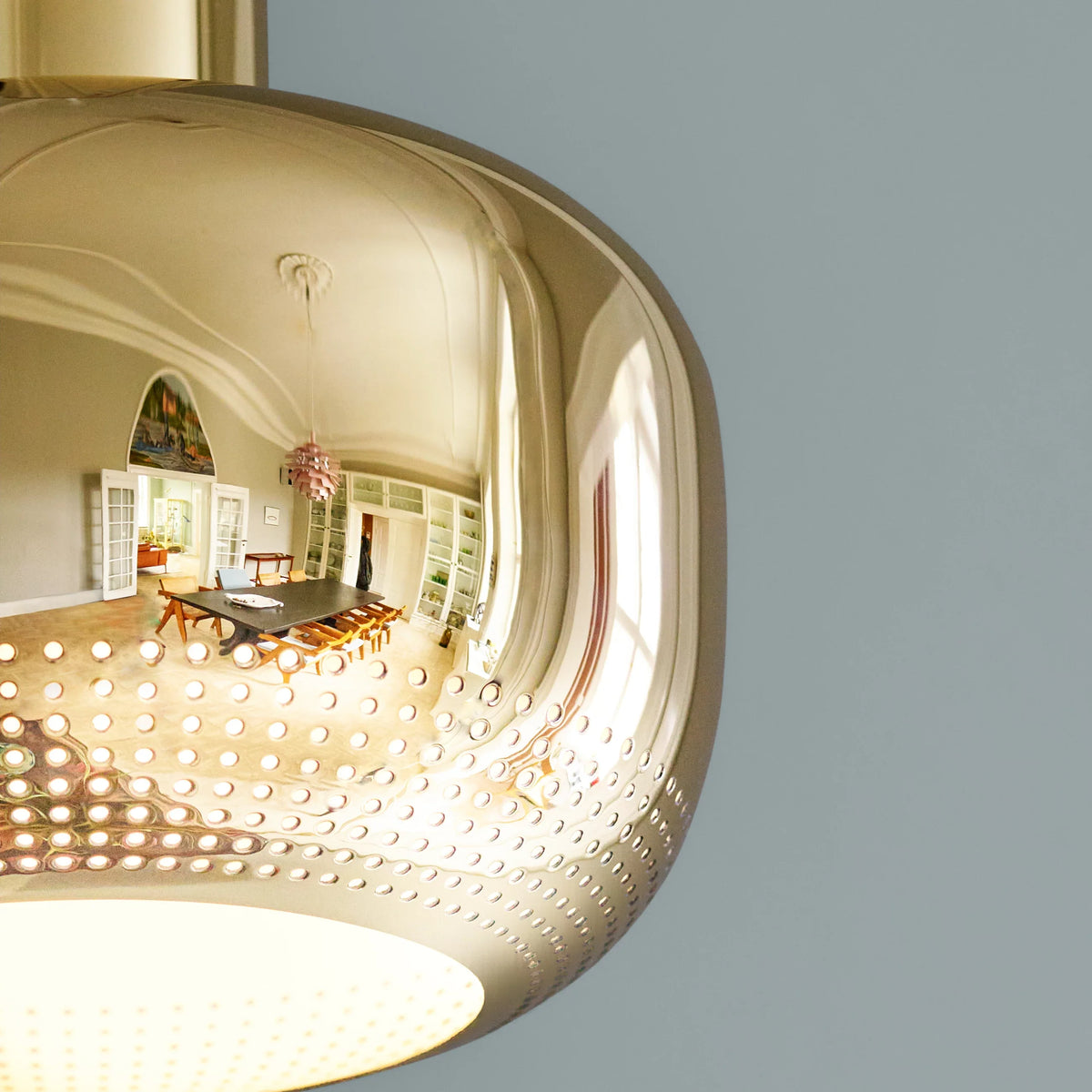
Which Pale Rose PH lamp suits your walls, wood and room?
Pale Rose reads strongest on dark walls. Hang the PH 3½-3 over a table, the Artichoke in a big room, the PH 3/3 in a bedroom, the Question Mark on a desk.

Short answer: Pale Rose reads strongest against dark walls and calmest against warm white and light oak, so let your walls decide how much pink you want to see. For a dining table we would hang the wide, flat PH 3½-3, for a big room or stairwell the 60 cm Artichoke, for a bedroom the PH 3/3, and on a desk or nightstand the PH 2/2 Question Mark.
All four lamps are Poul Henningsen designs in the same Pale Rose colour, but the pink sits in different places. On three of them it is mouth-blown, four-layered glass with a white sandblasted underside. On the Artichoke it is lacquer on 72 steel leaves around a chrome-plated frame. That difference, more than the colour name, decides how each one behaves in your room.
Where the pink actually shows
On the glass lamps the colour lives on the outside of the shade. The undersides are sandblasted white, so much of the light that lands on a table or a book bounces off white glass first, while the shade itself glows pink. Lit at night, the room sees a rose-coloured object; the work surface below sees a softer, less tinted light.
The PH Artichoke Pale Rose Pendant works the other way. The light reflects off the lacquered leaves themselves, so the colour is part of what reaches the room, and with the lamp off you still have a large pink form overhead. Henningsen drew it in 1958 for the Langelinie Pavillonen restaurant in Copenhagen.

Four lamps, side by side
All figures come from the product specifications.
| Lamp | Width x height | Weight | Cord | Max bulb | Where the pink is |
|---|---|---|---|---|---|
| PH 2/2 Question Mark (table) | 27.5 x 41 cm, 20 cm deep | 5.1 kg | 2.8 m with plug | E27, 25 W | Glossy glass outside, white inside |
| PH 3/3 pendant | 28.5 x 30.7 cm | 5.6 kg | 4 m | E27, 70 W | Glass, white sandblasted underside |
| PH 3½-3 Brass pendant | 32.7 x 21.9 cm | 5.1 kg | 3.2 m | E27, 60 W | Glass, white sandblasted underside |
| PH Artichoke pendant | 60 x 58 cm | 11.1 kg | 4 m | E27, 100 W | Lacquered steel leaves, chrome frame |
The two glass pendants are easy to confuse, and only one has "Brass" in its name. Both spec sheets list the same glass and the same brushed, untreated brass with fine hairlines; the PH 3/3 Pale Rose Pendant also names a brass canopy. The real difference is shape. The PH 3/3 is taller than it is wide (30.7 by 28.5 cm), a compact stack. The PH 3½-3 Pale Rose Brass Pendant is wider and flatter (32.7 by 21.9 cm), with a broad top shade that spreads light across a table.
White walls, oak and darker rooms
- Bright white walls: the pink shows clearly as a colour, almost an accent. For a quieter pink, pick a glass lamp; to make it the point of the room, the Artichoke.
- Warm white, plaster or greige: the easiest match. Pale Rose sits close to these tones, so all four look settled rather than added.
- Light oak and honey wood: pink, brass and oak are all warm, and three warm notes together can go flat. The Artichoke's chrome frame adds a cool counterpoint; with the glass lamps, keep some white or grey nearby, as in the kitchen below.
- Dark walls (deep green, blue, charcoal): this is where Pale Rose does most. A pale glowing shade against a dark wall is a strong contrast, and even the smaller PH 3/3 holds its own.
- Dark or rough wood: the brushed brass on the glass lamps shines against it; see the Question Mark on weathered timber further down.

Hanging numbers for a dining table
We would hang the PH 3½-3 50–60 cm above a dining table, and start the PH 3/3 in the same range. Here is the working for a 260 cm ceiling and a 75 cm table, so the bottom of the shade ends up 125–135 cm from the floor, or 125–135 cm below the ceiling.
- PH 3½-3 (21.9 cm tall): about 103–113 cm of cord below the ceiling, well within the 3.2 m supplied.
- PH 3/3 (30.7 cm tall): about 94–104 cm of cord, with 4 m supplied.
- Artichoke (58 cm tall): about 67–77 cm of cord. At 60 cm across, it leaves 15 cm on each side of a 90 cm wide table, so it wants a generous table or a room with no table under it at all.
The Artichoke weighs 11.1 kg, so make sure the ceiling fixing is made for that load before it goes up. More on this in how high to hang a PH pendant over a dining table.

Which Pale Rose lamp we would choose
Over a dining table or kitchen island: the PH 3½-3. Its flat 32.7 cm shade spreads light across the table, and a long table or island takes two.
For a large dining room, hall or stairwell with height to spare: the Artichoke. At 60 cm and up to 100 W it can carry a room by itself, and with pink lacquer on every leaf it is the biggest block of colour of the four, lit or not.
For a bedroom, dressing area or a dark-walled corner: the PH 3/3. It is compact, taller than wide, and against a deep colour it does a lot for its 28.5 cm.
For a nightstand or desk, or to try the colour before committing to a ceiling light: the PH 2/2 Question Mark Pale Rose Table Lamp. Its 25 W maximum makes it a mood and reading light rather than a room light, and the 45° tilting head, a 1931 idea, lets you aim it at a page or at the wall.
If your walls are white and your floors are oak and you are still unsure, start with the PH 3½-3 over the table; it shows the colour without asking the room to change. The rest of Henningsen's work, in other finishes, is in our Poul Henningsen collection.