


TECNOLUMENDesign: Wilhelm Wagenfeld
Arrives Dec 14 to 24 to the United States
In stock at TECNOLUMEN's warehouse, dispatched in 2‑3 weeks
Import duties & tariffs included, no customs charges on delivery. Sales tax calculated at checkout
Shipping and returns- Dimensions
- 180 (width) x 360 (height) x 180 (length) mm · Base Ø 160 mm
- Material
- Nickel-plated metal with a black-lacquered base and a hemispherical opal-glass shade
- Light source
- E27 (E26 compatible), 1 bulb, max 60 W. IP20, indoor. Bulb not included.
- Weight
- 30-day returns
- Authorized dealer
- Secure payment
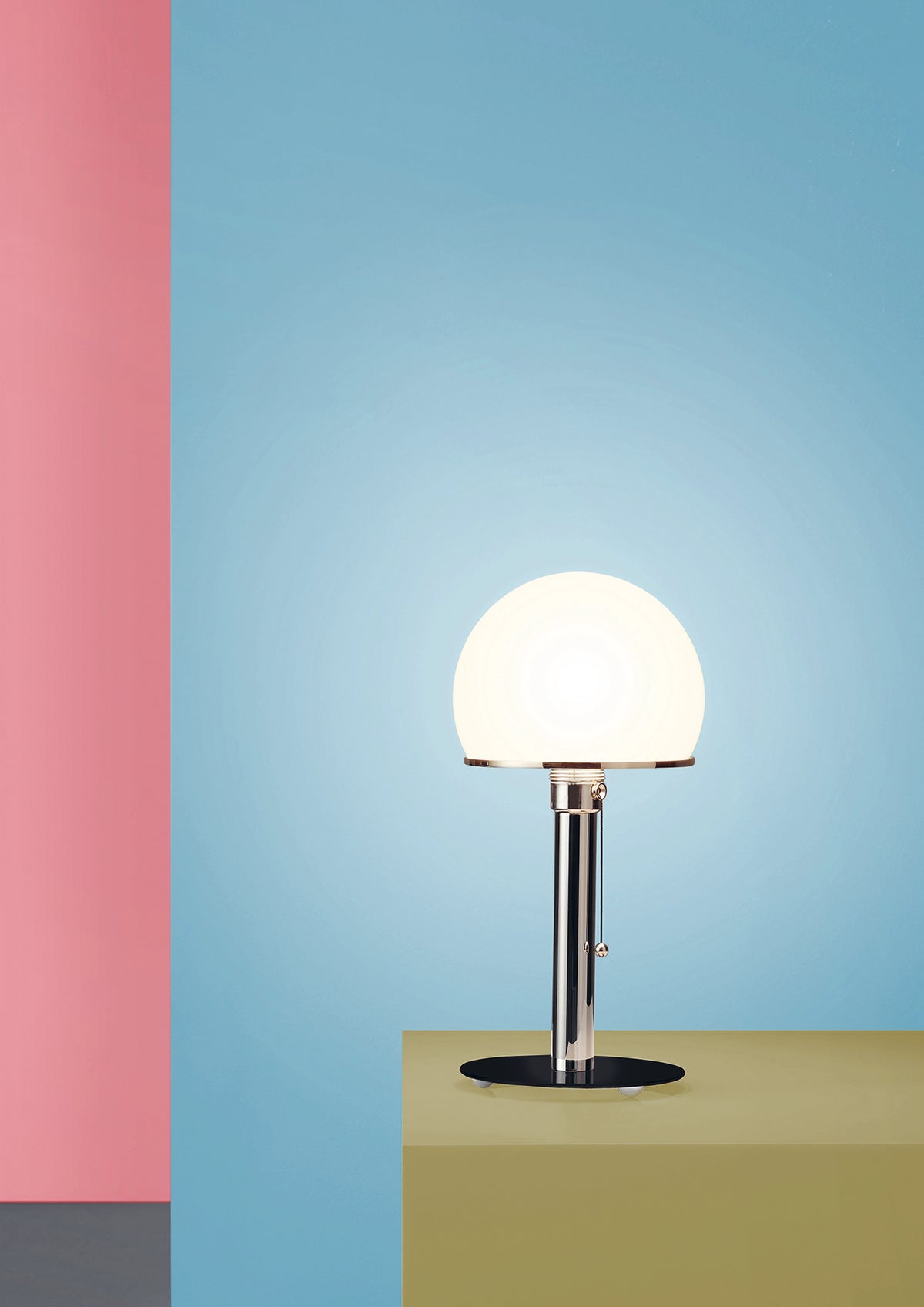
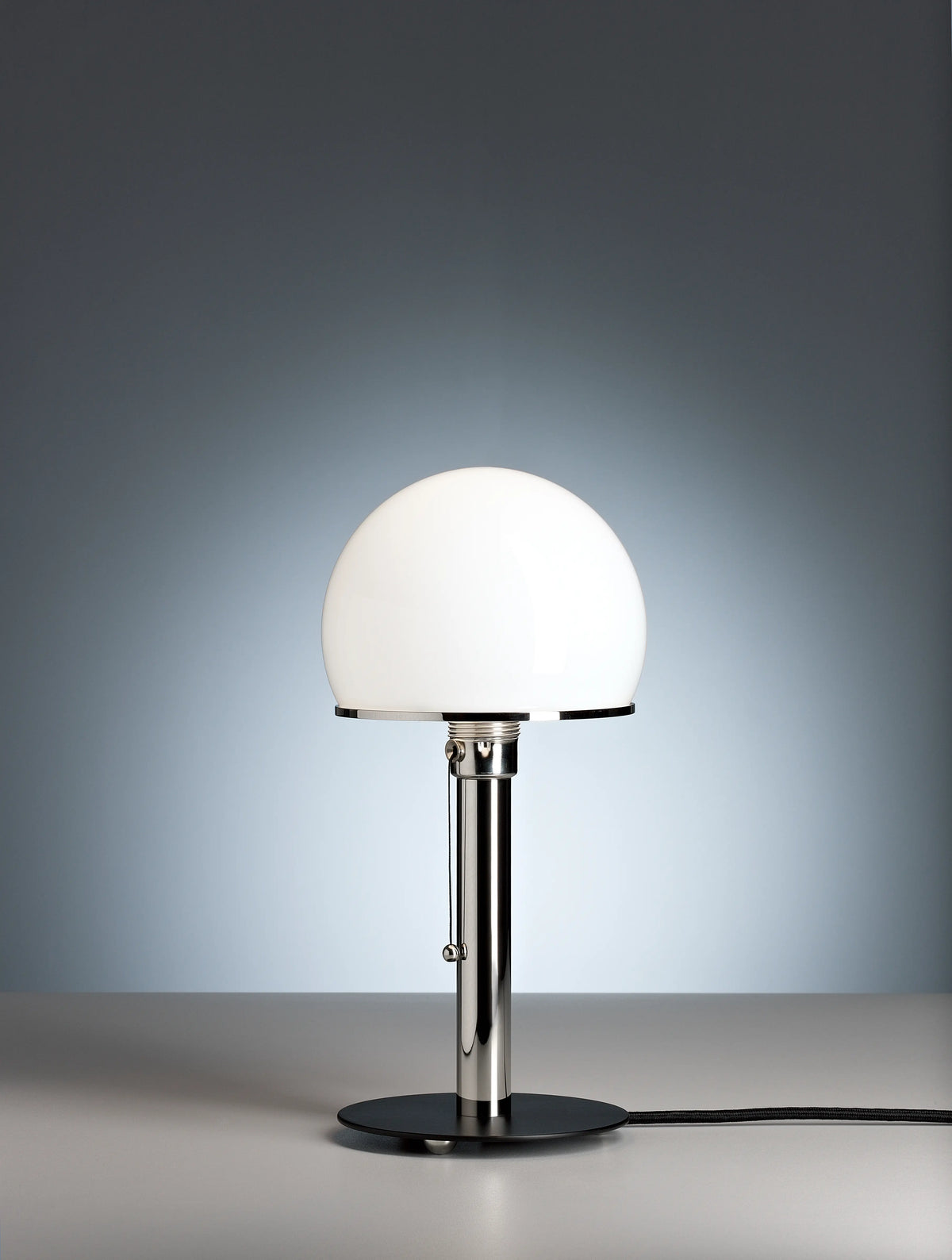
Wilhelm Wagenfeld's WA 23 SW (1924) pairs a black-painted base and nickel-plated stem with an opal-glass globe. TECNOLUMEN reproduces it exactly as the official Bauhaus lamp, each unit consecutively numbered under the base. A soft, diffused glow from the sphere epitomises early modernist simplicity, a cornerstone of Bauhaus lighting.
The design dates from Wagenfeld's time as a young apprentice in the metal workshop of the Bauhaus in Weimar, where students were challenged to create objects suited to industrial production rather than handcrafted decoration. Wagenfeld's answer was disarmingly logical: a circular base, a cylindrical stem and a spherical opal-glass shade, pure geometry doing the work that ornament used to do. The result became known simply as the Bauhaus lamp, one of the most recognisable objects of early modernism and a textbook example of the school's belief that everyday things should be honest about how they are made. In the WA 23 SW variant, the black-painted base anchors the composition and gives the lamp a more graphic, grounded presence than its all-metal siblings, while the nickel-plated stem and glowing globe keep the original lightness intact. TECNOLUMEN in Bremen produces the authorised re-edition, numbering every lamp consecutively under the base, a genuine piece of design history rather than a lookalike. You can explore the wider catalogue of these faithful re-editions in our Tecnolumen collection.
A century on, the WA 23 SW remains one of the easiest design classics to live with. The opal globe casts a soft, non-directional glow that flatters a desk, a sideboard or a bedside table equally well, and the modest footprint suits the compact apartments of Seoul, Tokyo or Hong Kong, where one well-chosen object often has to do the work of several. Try it as a warm counterpoint to minimalist interiors, or let it bring a note of calm order to a busier room; our guide to designer lighting for small apartments covers how to position a lamp like this for the biggest effect. If you are comparing silhouettes, the full range of table lamps sets the Bauhaus original alongside its Scandinavian descendants.
Light source: E27 (E26 compatible), 1 bulb, max 60 W. IP20, indoor. Bulb not included, we recommend an E27 LED (6–10.5 W, 480–1055 lm).
| Brand | TECNOLUMEN |
|---|---|
| Designer | Wilhelm Wagenfeld |
| Size (mm) | 180 (width) x 360 (Height) x 180 (Length) |
| Dimensions | Base Ø 160 mm |
| Material | Nickel-plated metal with a black-lacquered base and a hemispherical opal-glass shade. Each lamp consecutively numbered with the TECNOLUMEN / BAUHAUS logo. |
| Light source | E27 (E26 compatible), 1 bulb, max 60 W. IP20, indoor. Bulb not included, we recommend an E27 LED (6–10.5 W, 480–1055 lm). |
| Item number | WA 23 SW |
| EAN |
- Delivery to United States: 12–14 business days (after dispatch).
- 30-day returns.
- Import duties & tariffs included, no customs charges on delivery. Sales tax calculated at checkout.

Compare within the series
This product WA 23 SW Bauhaus Table Lamp |  WA 24 Bauhaus Table Lamp |  WG 24 Wagenfeld Table Lamp |  WG 25 GL Bauhaus Table Lamp | |
|---|---|---|---|---|
| Size | ||||
| Size | Size (mm): 180 (width) x 360 (height) x 180 (length) Base Ø 160 mm | Size (mm): 180 (width) x 360 (height) x 180 (length) Base Ø 160 mm | Size (mm): 180 (width) x 360 (height) x 180 (length) Base Ø 152 mm | Size (mm): 180 (width) x 360 (height) x 180 (length) Base Ø 152 mm |
| Light source | ||||
| Light source | E27 (E26 compatible), 1 bulb, max 60 W | E27 (E26 compatible), 1 bulb, max 60 W | E27 (E26 compatible), 1 bulb, max 75 W | E27 (E26 compatible), 1 bulb, max 60 W |
| Material | ||||
| Material | Nickel-plated metal with a black-lacquered base and a hemispherical opal-glass shade | Round glass base plate and glass shaft | Clear glass base plate and glass shaft enclosing the metal tube | Nickel-plated metal with a glass base and a hemispherical opal-glass shade |
| Price | ||||
| Price | $599.00 | $599.00 | $599.00 | $599.00 |
TECNOLUMEN
The 1924 Bauhaus lamp, still made in Bremen
DesignerWilhelm Wagenfeld1900–1990
Wilhelm Wagenfeld designed this table lamp in 1924 at the Bauhaus in Weimar, as an assignment from László Moholy-Nagy. Circle, cylinder and hemisphere are all it needs. TECNOLUMEN has made it since 1980 as the only re-edition Wagenfeld personally authorised.
- Year Wagenfeld designed the lamp
- 1924
- Authentic versions: WG 24, WA 24, WG 25 GL, WA 23 SW
- 4
- Height, with an 18 cm shade
- 36 cm
- In the shop of MoMA New York since
- 1986
The authorised original
Wagenfeld licensed Walter Schnepel personally. Each lamp is numbered and marked TECNOLUMEN / BAUHAUS.
Four versions
WG 24 with clear glass base and stem, WA 24 in nickel-plated metal, WG 25 GL with glass base and metal stem, WA 23 SW with a black base.
Soft, even light
The mouth-blown opal glass shade diffuses the light evenly across a desk or bedside.
Made to last
Individual parts can be replaced, so the lamp can be kept in use for generations.
A Bauhaus assignment
Wagenfeld joined the Bauhaus metal workshop in Weimar as a young journeyman. He designed the lamp to suit industrial production, yet the first ones were made by hand, as a mini-series for the 1924 Leipzig Autumn Fair.

Glass and nickel
On the WG 24, a nickel-plated tube runs inside the clear glass stem and carries the cable. Metal parts are nickel-plated, as on the original, not chrome, and may take on a slight yellowish patina over time.
How to know the original
Look for the serial number and the TECNOLUMEN / BAUHAUS mark under the base, a black pull cord ending in a small nickel-plated ball, and a black textile cable. A Hamburg court confirmed Wagenfeld's authorship in 1999.
Materials
- Mouth-blown opal glass
- Used for every shade; small variations from hand blowing make each one unique.
- Clear glass
- Base and stem of the WG 24 and base of the WG 25 GL, never plastic.
- Nickel-plated metal
- Base, stem and fittings; wipe with a soft, dry cloth.
Born in Bremen, Wagenfeld trained as a silversmith before joining the Bauhaus in Weimar in 1923. He went on to design heat-resistant glass for Schott in Jena, the stackable Kubus glassware and products for Braun and WMF. He left more than 600 designs, mostly in glass and metal.
Using it at home
Which bulb does it take?
One E27 bulb. TECNOLUMEN recommends a 7 W frosted LED.
How do I switch it on?
With the black pull cord, which ends in a small nickel-plated ball.
Which version should I choose?
WG 24 for the classic clear glass look, WA 24 for a solid metal presence, WG 25 GL for glass with a metal stem, and WA 23 SW for a black base.
Why is the metal slightly yellow?
The parts are nickel-plated like the original, and nickel can develop a subtle yellowish patina with time. This is normal.
How do I clean it?
Let it cool. Wipe the glass with a soft, damp cloth and dry it, and dust the metal with a dry cloth.
-
 ORIGINAL DESIGN
Authorized dealer for every brand, 100% authentic guaranteed.
-
 EXPERT SUPPORT
Count on our specialists for advice, from selection to aftercare.
-
 FREE SHIPPING
Free delivery to United States on orders over $499
-
 SECURE PAYMENT
We only use trusted providers for a safe, seamless checkout.


